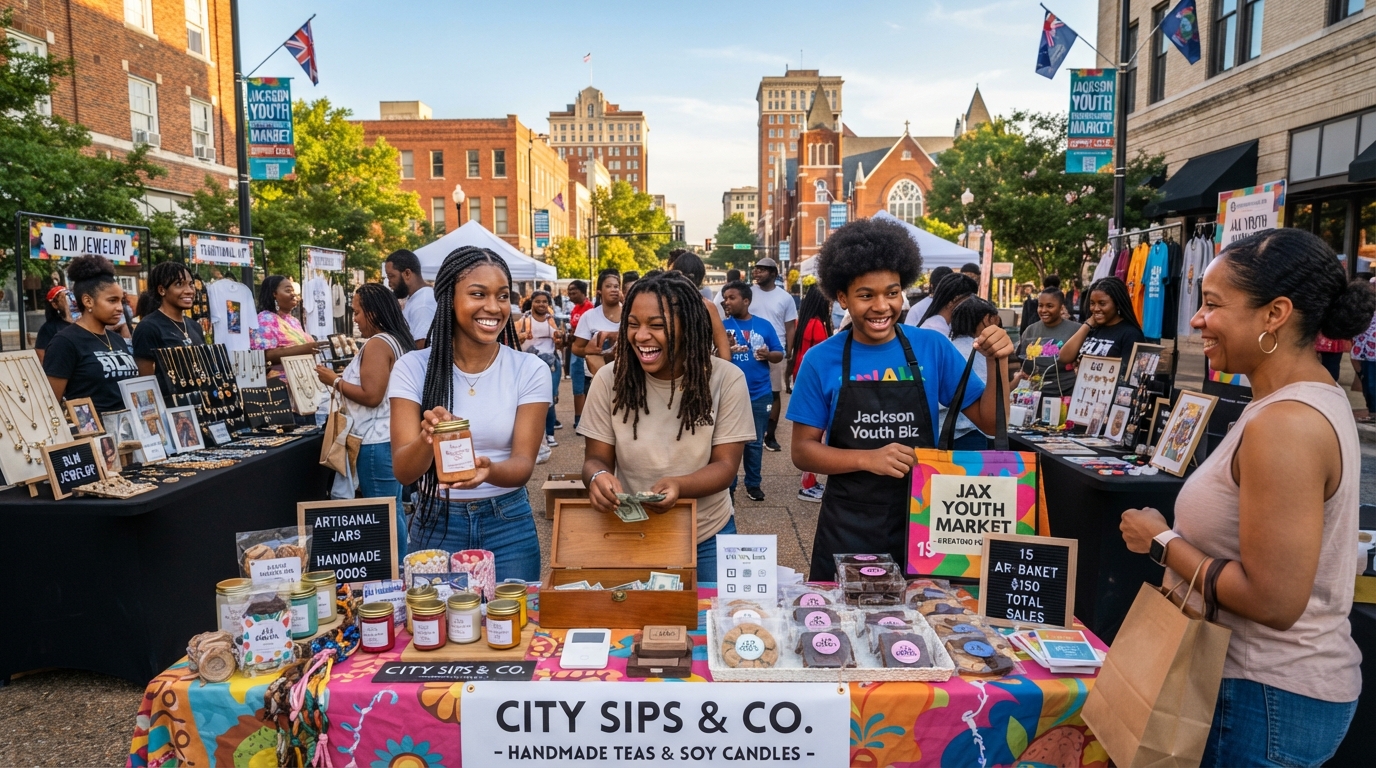
There is a tired story we keep telling about young people in Jackson.
They are distracted. They lack ambition. They spend too much time online. They need someone to teach them how to work.
I do not believe that story.
Because if you actually pay attention to what young people around Jackson are doing, you will find teenagers running service businesses, children creating brands, students pitching business ideas, young authors teaching financial literacy, and elementary students learning how to program robots.
Jackson kids are already building.
The more important question is whether we have created enough places for them to keep going once the first project, market, competition, or school assignment ends.
Some of Our Young People Are Already Thinking Like Owners
In 2025, Mississippi Today profiled Christopher Steverson, then a senior at Callaway High School.
Christopher was already helping run a lawn-care business with his father while developing a streetwear line of his own. He had also inherited two properties from his father, which meant that before graduating from high school, he was already being exposed to entrepreneurship, branding, property ownership, and wealth-building.
That is worth paying attention to.
At the Entrepreneurship and Employability Skills Symposium in Jackson, Christopher was learning more about credit and real estate. Those are conversations many adults wish someone had introduced to them much earlier.
We spend a lot of time asking teenagers where they plan to work after graduation.
We should also be asking them what they might own.
Jackson Has Young Entrepreneurs Teaching Other Young People
Then there are Nick Brown and twins Khaliq and Kharim Brown, the young entrepreneurs behind Boss Brothers Universe.
They have created books and digital content focused on helping children understand entrepreneurship and financial literacy. At the 2025 Entrepreneurship and Employability Skills Symposium, the brothers were invited to speak to high-school students about business.
Nick was 14. Khaliq and Kharim were 11.
Think about what that represents.
Children from Jackson were standing in front of older students talking about money, entrepreneurship, and ownership from experience.
That story deserves to be told just as loudly as the stories we hear about what young people are supposedly doing wrong.
Perhaps louder.
Because children need examples that are close enough to touch.
A 12-year-old entrepreneur from your own community can sometimes make possibility feel more real than a billionaire on television ever could.
More Than 70 Young Entrepreneurs Took Their Products to Market
In April 2026, more than 70 middle-school students from Jackson, Canton, Okolona, and Tupelo participated in the Choose to Grow Market Day in downtown Jackson.
Before reaching the market, students had participated in a Shark Tank-style competition, developed their ideas, worked with mentors, and prepared products to sell to actual customers.
Then they opened for business.
People walked through the market, chose what they wanted to purchase, handed students real money, and the young entrepreneurs kept the profits they earned.
That part matters.
You can explain entrepreneurship to a child for hours, but there is something different about the first time someone pays for something you created.
Now the questions become real.
- How much did it cost to make?
- Did I charge enough?
- Why did that customer stop at my table?
- Why did another person walk past?
- Which product sold fastest?
- Should I make more?
- What am I going to do with the money?
That is where business education starts becoming business experience.
Jackson Public Schools Is Giving Students Business Exposure Too
Callaway High School's Academy of Business, Marketing & Finance gives students exposure to areas such as business management, entrepreneurship, marketing, finance, business planning, networking, and work-based learning.
Students have opportunities to develop business plans and participate in pitch-style experiences that force them to think beyond having an idea.
That kind of exposure matters because most children are taught how to become employees long before anyone explains what it means to become an employer.
There is nothing wrong with preparing young people for careers. We need that.
We also need young people who understand how businesses make money, why companies fail, how customers make purchasing decisions, what it means to build equity, and what happens when someone decides to create the job instead of applying for one.
Those conversations should begin before adulthood.
And Some of This Starts Much Younger Than High School
Entrepreneurship is only part of the story.
In 2025, fourth-grade students participated in the C3 Jr. Coding Challenge at the Mississippi Children's Museum in Jackson. Teams designed obstacle courses and programmed robots to complete them.
Fourth grade.
That tells us something important about what children are capable of when someone gives them access to the tools and a problem worth solving.
We sometimes wait far too long to introduce children to technology because adults have decided a subject is "advanced."
Children do not necessarily see it that way.
Give them the equipment. Explain the problem. Let them experiment.
That child programming a robot today may become an engineer. She may become a business owner. He may develop software. Another student may never work in technology professionally but could still grow up understanding how to use technology to solve problems inside whatever business or career they choose.
That exposure has value long before anyone chooses a profession.
So Let's Retire One Excuse
We do not need to wonder whether young people around Jackson have ideas.
They do.
We do not have to wonder whether they are interested in entrepreneurship.
We have evidence that they are.
Around 200 high-school students from the Jackson metro participated in the 2025 Entrepreneurship and Employability Skills Symposium. Students learned about financial literacy, business development, careers, real estate, and entrepreneurship. Teams competed in a business pitch competition, and winning students received money they could save or reinvest in their businesses.
Our young people are showing up when these opportunities are offered.
Now I want to know what happens afterward.
The Question NEXT Keeps Asking: Then What?
A middle-school student has a great Market Day.
Then what?
A high-school student wins a pitch competition and receives $250.
What happens six months later?
A student writes an impressive business plan in class. Does anybody help them test whether customers will actually buy the product?
A child discovers they love coding. Where do they go next?
A teenager starts doing hair, making desserts, cutting lawns, designing flyers, selling clothes online, or making bracelets. At what point does somebody sit down with that young person and explain pricing, bookkeeping, taxes, marketing, customer retention, or what it would take to grow?
That is where I see an opportunity.
Jackson already has people doing good work with young people. Schools are introducing entrepreneurship. Organizations are hosting markets. Students are participating in business competitions. Families are helping children launch their first businesses.
We should build on that work.
The missing piece is often continuity.
One Event Cannot Carry an Entrepreneur
A pitch competition can light a fire.
A market can show a child that people will buy something they created.
A workshop can introduce an idea they have never considered before.
But business gets harder after the excitement wears off.
- The customer complains.
- The product costs more than expected.
- Sales slow down.
- You realize your price makes no sense.
- You spend your revenue before understanding that some of that money belongs to the business.
- A friend who seemed like a great business partner stops doing their share of the work.
- Your social-media page gets attention, but nobody buys anything.
- You need supplies and do not have enough cash to purchase them.
That is entrepreneurship too.
Those moments are frustrating, but they are incredibly valuable when they happen while a young person has adults around them who can help explain what went wrong and what to try next.
I would rather see a 14-year-old make a $40 business mistake and learn from it than meet that same lesson for the first time at 34 with payroll due on Friday.
That Is Where NEXT Comes In
NEXT is not being created because nobody else in Jackson cares about youth entrepreneurship.
Quite the opposite.
The work already happening proves there is demand.
NEXT is being built to give young people another place to continue.
A student may come to us with nothing more than an idea.
- Maybe they already have a business.
- Maybe they sold something once and do not know what comes next.
- Maybe they are the child constantly coming up with inventions.
- Maybe they love technology.
- Maybe they have no idea what they want to build yet.
That is fine too.
The goal is to help them move forward.
We want young people learning how to understand a customer, develop an offer, price what they sell, manage money, market themselves, use technology, build a brand, communicate professionally, and make decisions based on what is actually happening in their business.
They should have opportunities to sell.
They should meet people who run real companies.
They should learn what happens beyond the exciting part of coming up with an idea.
And if the first idea fails?
Good.
Figure out why.
Try something else.
Learning that failure can provide information instead of becoming a reason to quit may be one of the most valuable business lessons they ever receive.
Please Stop Calling Their Businesses "Cute"
This is one thing I would love for adults to change.
A child starts selling something and we immediately turn it into a novelty.
"Awww, look at the little entrepreneur!"
Meanwhile, that child may be trying to figure out something adults struggle with every day: how to convince another human being to exchange money for value.
Take them seriously.
- Ask how much the product costs to make.
- Ask how they decided on the price.
- Ask who they think their customer is.
- Ask what has sold best.
- Ask what they are doing with the money.
- Ask what they want the business to look like next year.
If the product is good, buy it.
If the service is good, recommend them.
If something needs work, teach them.
Respect tells a child that what they are building matters.
Jackson Needs to Make These Young People Visible
One thing became very clear while researching this article.
The stories are scattered.
One young entrepreneur appears in a newspaper story. Another is featured through a school program. Someone else participates in a community market. Another child is building something at home and may never receive public recognition at all.
How many young entrepreneurs around Jackson are completely invisible right now?
How many children are baking, designing, coding, fixing things, making products, creating content, cutting grass, doing hair, selling online, or solving problems without ever calling themselves entrepreneurs?
We need to find them.
And then we need to tell their stories.
Not because every child needs publicity.
Because visibility creates exposure for the next child.
A young person sees someone close to their age building something and thinks, Wait. I could do that.
That thought can change a life.
We Want to Know What Your Child Is Building
This is going to become part of The NEXT Chapter.
We want to feature young people from Jackson who are building businesses, creating products, developing technology, solving problems, making art, inventing things, or simply trying an idea for the first time.
And we want to help more children start.
If your child is already selling something, building something, coding something, creating something, or constantly talking about the business they want to start, sign them up for NEXT.
If they have no business yet but are curious about entrepreneurship, sign them up too.
Upcoming NEXT cohorts, markets, workshops, and youth business opportunities will give young people the chance to move beyond the idea stage and experience what it actually means to build.
Because the next generation of Jackson business owners is not twenty years away.
Some of them are already working.
The question we should be asking them now is simple: What are you building, and what do you need to keep going?
Sign Up for NEXT
Register your interest in upcoming NEXT youth entrepreneurship cohorts, the NEXT Market, workshops, and other opportunities for young builders in Jackson.
If they have an idea, we want to hear it. If they have already started, we want to help them keep going.