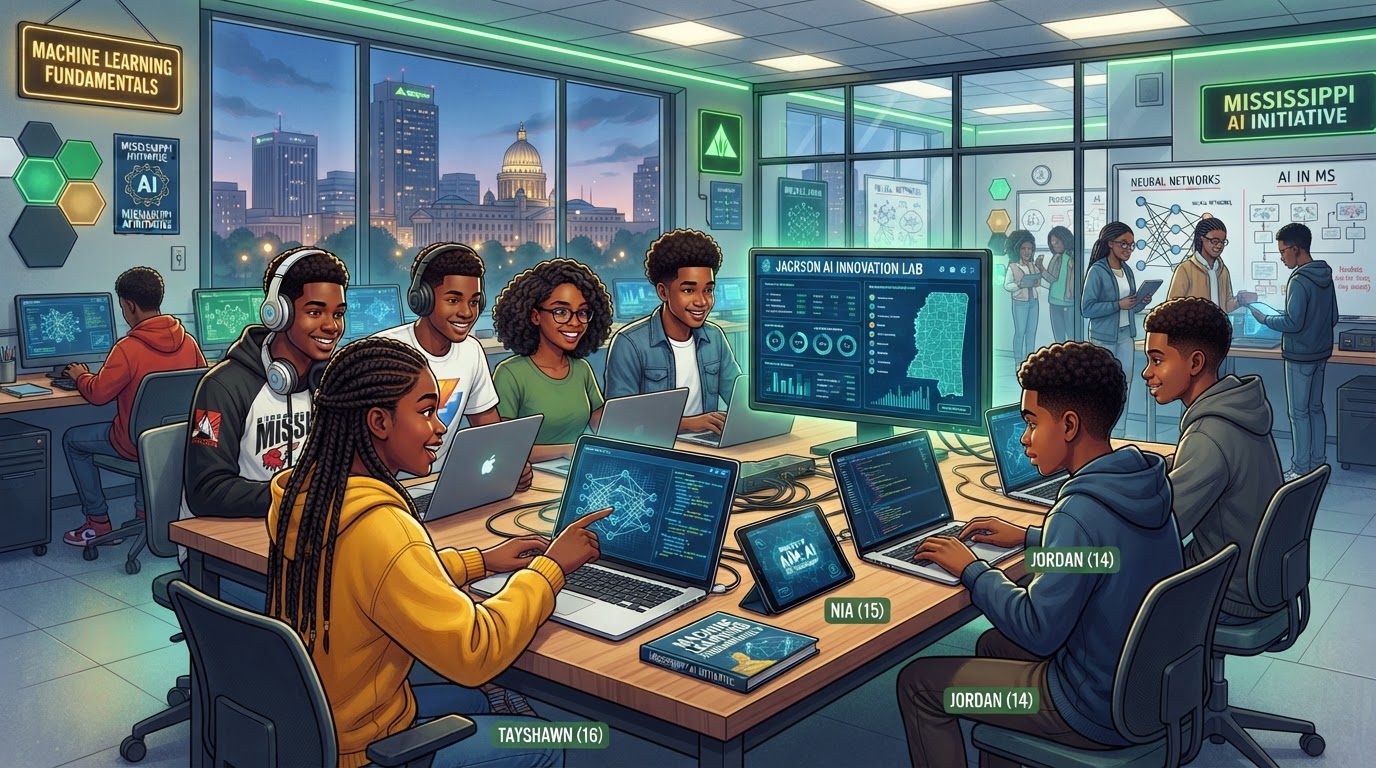
Mississippi is already doing serious work around artificial intelligence.
That matters.
Because too many conversations about AI still sound like something happening somewhere else. Silicon Valley. New York. Austin. Atlanta.
Meanwhile, right here in Mississippi, the Mississippi AI Collaborative is training educators, supporting small businesses, creating free learning pathways, and connecting students to real-world AI work.
The organization says its goal is to make sure every student, educator, and business in Mississippi has access to the tools, training, and opportunities needed to participate in an AI-driven economy. Its current numbers are worth paying attention to: more than 3,400 people engaged, 1,400 educators trained, and 86 businesses supported.
That is progress.
But I keep coming back to one question.
Who gets reached first, and who gets reached last?
Because the existence of opportunity does not mean access is equal.
AI Is Already Changing What Work Looks Like
Artificial intelligence is not some distant technology our children can worry about later.
It is already changing how businesses market, sell, hire, create, analyze data, communicate with customers, build software, manage operations, and make decisions.
Children growing up right now are going to enter a workforce where AI literacy may be as basic as knowing how to use email or search the internet.
That changes what preparation should look like.
It is no longer enough to ask whether students can use a computer.
- Can they work with AI?
- Do they understand what these tools can do?
- Can they recognize bad information?
- Can they build something with them?
- Can they use AI to solve an actual problem?
- Can they understand the risks, bias, privacy issues, and ethics involved?
That education should not begin only after someone gets to college.
And it definitely should not be reserved for children whose parents already know which programs, camps, certifications, and technology opportunities to look for.
This Is What Makes the Mississippi AI Collaborative Interesting
MSAIC is not treating AI education as one class for computer science students.
Its approach is much broader.
The organization runs an AI Educator Accelerator that helps Mississippi teachers bring AI into classrooms. It has trained more than 1,200 educators according to its current organizational materials.
That matters because teachers multiply access.
Train one educator and that knowledge can reach dozens, sometimes hundreds, of students over time.
MSAIC also runs an AI Agency, where university students work with Mississippi small businesses and nonprofits on real business problems using artificial intelligence. Businesses can participate in accelerator programs that include hands-on training and customized AI solutions.
That part caught my attention.
Students are not just sitting in a room hearing someone explain AI.
They are using it.
They are working with actual organizations.
They are seeing what happens when technology meets payroll, marketing, customer service, operations, fundraising, and growth.
That is exposure.
And exposure changes what a young person believes is possible.
Mississippi's AI-Thon Makes Access Even More Interesting
The Mississippi AI Collaborative's 2026 AI-Thon is free.
Participants can choose learning pathways based on their experience and interests, including AI basics, business and entrepreneurship, education, nonprofit work, responsible AI, cybersecurity, creative media, health innovation, and agriculture.
Free matters.
Especially in a state where cost can immediately shut families out of educational opportunities.
But free alone does not solve the access problem.
- People still have to know the opportunity exists.
- A child needs internet access.
- A student may need a device.
- Someone may need an adult to explain why this matters.
- A teenager may have never heard the words "machine learning" outside of social media.
- Parents who are already overwhelmed with work, bills, transportation, school schedules, and everyday life may not be searching online for statewide AI programs.
That is where the conversation gets bigger.
We Cannot Confuse Availability With Access
This happens all the time.
A program exists.
A website exists.
Registration is open.
Then we say the opportunity was available to everyone.
Technically, maybe.
Practically, no.
Real access means children know about the opportunity early enough to participate.
- Their teachers know about it.
- Parents understand why it matters.
- Schools have the technology to support it.
- Transportation is not standing in the way of an in-person experience.
- Students see people who look like them participating.
- Someone tells them, "You belong in this room."
Those details determine who actually shows up.
And if we ignore them, the same children who have historically been left out of high-growth industries can end up being left out of AI too.
Only this time the gap could grow much faster.
Jackson Cannot Afford to Miss This
Jackson already has a youth opportunity problem.
We have children growing up inside Mississippi's capital city who may be surrounded by universities, hospitals, government institutions, businesses, and technology, yet never get meaningful exposure to how those systems work.
Now add artificial intelligence.
This technology could become one of the biggest economic shifts of their lifetime.
What happens if Jackson children are introduced to it primarily as consumers?
- They ask ChatGPT questions.
- They generate pictures.
- They make funny videos.
- Maybe they use AI to help with homework.
Meanwhile, another child is learning to build an AI workflow for a business.
Another is learning Python.
Another is designing a product.
Another is working with data.
Another is learning how AI can reduce costs inside a company.
They are all "using AI."
They are not gaining the same advantage.
That difference matters.
I Do Not Want Jackson Children Trained Only to Use Somebody Else's Technology
This is where my concern goes beyond workforce development.
I want children to understand ownership here too.
- Who builds AI companies?
- Who owns the software?
- Who gets paid to implement these systems for businesses?
- Who creates the data products?
- Who starts the consulting firms?
- Who builds tools specifically for Mississippi industries?
- Who owns the intellectual property?
Those are different questions from, "Do you know how to use ChatGPT?"
We should teach both.
Mississippi needs people who can work inside an AI-driven economy.
It also needs people capable of building businesses inside it.
That is how technology becomes economic development instead of another thing we buy from somewhere else.
The Mississippi AI Collaborative Is Showing What Early Infrastructure Can Look Like
MSAIC has already built partnerships around education, workforce development, higher education, and business support.
Its partners and programs include Jackson State University, Mississippi Coding Academies, The Bean Path, educators across the state, and private-sector supporters.
Its Southern Spark Conference was also held at Jackson State University in June 2026, bringing educators, entrepreneurs, technologists, policymakers, and community leaders together around applied AI.
That is the kind of activity Jackson should want more of.
Not because conferences are the goal.
Because ecosystems matter.
- A student hears a speaker.
- A teacher learns a tool.
- A nonprofit discovers a better process.
- A business owner meets someone with technical skills.
- A college student works on a real project.
Those relationships can turn into jobs, companies, internships, and ideas that never would have existed otherwise.
But we should keep asking who is missing from the room.
Start Younger
This may be the biggest opportunity.
We have a habit of waiting.
- Career readiness starts late.
- Entrepreneurship education starts late.
- Technology training often starts late.
Then we act surprised when students reach adulthood without the skills employers are demanding.
AI gives Mississippi a chance to do something different.
- Introduce it earlier.
- Let middle-school students experiment with it.
- Teach high-school students how businesses use it.
- Let them build.
- Give them ethical problems to think through.
- Let them work on community challenges.
- Let them see AI applied to agriculture, healthcare, transportation, small business, education, and public service.
- Then let them imagine what they could create.
A child does not have to become a software engineer for AI education to matter.
- The future restaurant owner will use AI.
- The future contractor will use it.
- The future nurse will interact with it.
- The future attorney, marketing professional, teacher, filmmaker, entrepreneur, accountant, and nonprofit leader will too.
This touches almost everybody.
The Bigger Question for Jackson
The Mississippi AI Collaborative is proving that AI education and workforce development can happen here.
Now Jackson has to decide how serious we are about getting our children connected to it.
- That means schools paying attention.
- Parents paying attention.
- Businesses opening their doors.
- Community organizations helping families find these opportunities.
- Local leaders thinking about AI as economic development instead of treating it like a technology fad.
And those of us working with young people need to stop assuming somebody else is preparing them.
Because AI is moving whether Jackson is ready or not.
The opportunity is here.
The question is whether Jackson's children will be prepared to shape it, or simply live with whatever somebody else builds.
Prepare Your Child for the AI Economy.
NEXT Institute gives Jackson youth hands-on experience with AI, technology, entrepreneurship, and leadership — before adulthood. Enroll a student, become a mentor, or invest in the next generation.